Art Basel Qatar
Overview


This presentation offers a unique opportunity to deepen our understanding of the broad cultural and geographical scope of Farid Belkahia’s work. His art transcends national borders and regional frameworks, positioning itself at the intersection of multiple worlds. It forges
connections between the Maghreb and Sub- Saharan Africa, weaving together histories and cultures often separated by political and geographic boundaries. Likewise, his practice explores the intricate relationship between the Arab world and the African continent as a whole, offering a nuanced vision that challenges reductive or binary categorizations.
Beyond geography, Belkahia’s work navigates the delicate tension between memory and modernity. He re-engages ancestral traditions and cultural heritage, reinterpreting them through a contemporary lens that reflects evolving social, political, and aesthetic realities. This ongoing dialogue gives rise to a plural, vibrant, and dynamic vision of Africa — an Africa that embraces complexity, hybridity, and renewal. His work invites viewers to see the continent as a living, evolving force in constant negotiation with its past, its present, and its imagined futures.
The proposal for the prestigious Art Basel Qatar fair is precisely an opportunity to highlight what Farid Belkahia initiated as early as the 1960s and 70s: a truly decolonial approach to art. Rather than attempting to reconstruct a fragmented past, Belkahia sought to transform it into a living force — active, fluid, and continually metamorphosing. His reinvestment in local forms and indigenous knowledge was never nostalgic; it was a bold attempt to shape new cultural trajectories. In this sense, his work resonates with the notion of trance — a state of transition and intensity, where body and spirit find liberation through transformation.
Farid Belkahia is recognized as one of the founding figures of modern art in Morocco. He played a crucial role in redefining a modern artistic identity that remained deeply rooted in the spiritual, material, and symbolic traditions of his homeland. He began his studies at the École des Beaux-Arts in Paris in the 1950s, and later continued his training in Czechoslovakia, where he broadened his vision of art and culture in dialogue with international movements. Upon returning to Morocco, he was appointed director of the École des Beaux-Arts in Casablanca, where he spearheaded a radical pedagogical and artistic renewal — one that embraced local artisanal practices and cultural memory as a foundation for contemporary expression.
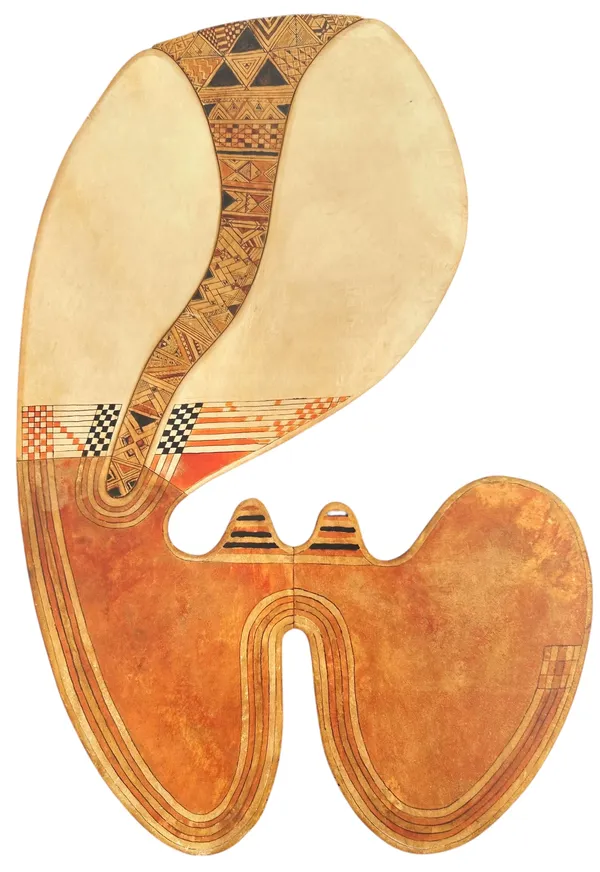
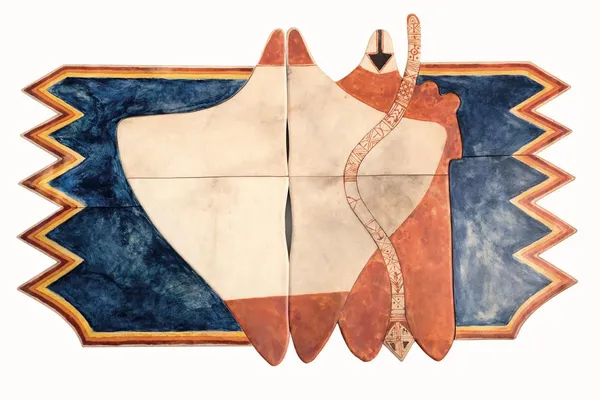
A turning point in his career came with his shift to natural and organic materials such as leather, copper, and natural pigments. This material transition allowed him to explore deeper themes related to identity, spirituality, and the human connection to the earth, all while developing a unique visual vocabulary that defied Western- centric norms.
Farid Belkahia passed away in 2014, leaving behind a rich intellectual and artistic legacy. His work — simultaneously local and universal —remains a vital reference in contemporary reflections on identity, decolonization, and creative innovation across Africa and the Global South.
Between 2003 and 2007, the gallery organized several solo presentations that traced the evolution of his artistic journey . These exhibitions gave Tunisian audiences a rare opportunity to engage with an artist whose practice challenged the conventional boundaries between art and craft, and who placed cultural heritage at the heart of a resolutely modern vision.Farid Belkahia was also featured in several group exhibitions organized by the gallery, most notably the 2016 exhibition Major Works by Arab Artists, which brought together key figures from across theArab world and reaffirmed Belkahia’s essential place within that broader artistic constellation.
Works


Installation Views


